The Science of Habit Formation: How to Build Routines
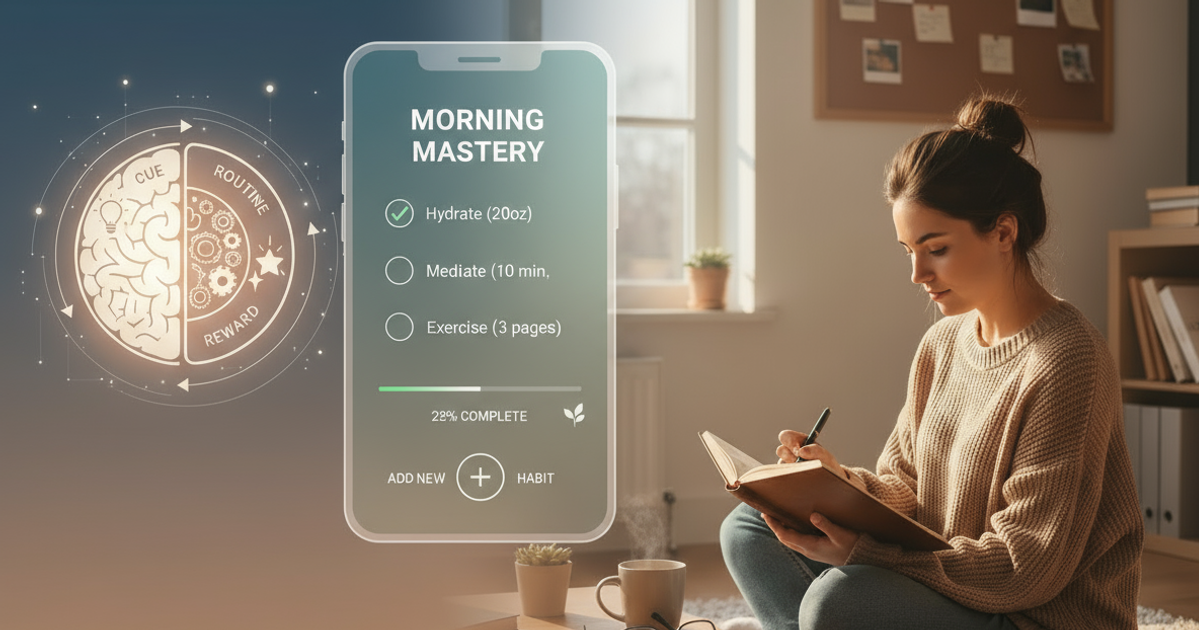
Building better habits is the holy grail of productivity, success, and overall life improvement. But here is the truth: Habit formation is not a willpower problem—it is a design problem.
Most people rely on motivation to change their lives. The problem? Motivation is a fleeting emotion, not a strategy. Real change happens when you understand the neurology behind your actions. Once you understand the "source code" of your brain, changing your life becomes easier, faster, and significantly more predictable.
In this guide, we will dismantle the psychology behind habits, show you how to break toxic patterns, and provide a step-by-step framework to build a lifestyle that lasts.
Why Willpower Isn't Enough
Good habits build your future; bad habits silently destroy it. The difference between success and failure isn't usually effort—it's system design.
When you master the science of habit formation:
- You eliminate decision fatigue: You stop arguing with yourself about whether to go to the gym.
- You create "Autopilot" behaviors: Hard tasks become automatic.
- You compound results: Small wins today equate to massive success over a year.
- You decouple success from motivation: You perform even on your "bad days."
1. The Neuroscience: How Habits Actually Work
To change a habit, you must understand where it lives in your brain.
Conscious decision-making happens in the Prefrontal Cortex. This area is smart but gets tired easily. Habits, however, reside in the Basal Ganglia—a primal part of the brain associated with emotions, memories, and pattern recognition.
When a behaviour becomes a habit, your brain shifts the workload from the Prefrontal Cortex to the Basal Ganglia to save energy. This process works through a neurological loop.
The Habit Loop (The Framework)
Psychologists identify a three-step loop that governs every habit you have:
- The Cue (Trigger): A signal that tells your brain to go into automatic mode.
- The Routine (Action): The physical, mental, or emotional behavior you perform.
- The Reward (Result): The benefit you get that tells your brain, "This is worth remembering."
Key Insight: Your brain does not crave the action (running); it craves the reward (the endorphin rush or stress relief).
2. How to Build Better Habits (The 4-Step Framework)
Creating habits becomes effortless when you stop fighting your brain and start working with it.
Step 1: Identity-Based Habits (The Mindset)
Most people focus on the outcome (lose 10kg). True behavior change happens at the level of identity.
Goal-Based Habits (Weak)
Identity-Based Habits (Strong)
"I want to write a book."
"I am a writer."
"I want to run a marathon."
"I am a runner."
"I want to stop smoking."
"I am not a smoker."
The Shift: When you act in alignment with who you believe you are, you don't need willpower. You just act like you.
Step 2: The 2-Minute Rule (Make it Stupidly Easy)
The hardest part of any habit is starting. This is the "Law of Least Effort."
- Don't aim to read 30 pages. Aim to read 1 page.
- Don't aim to do 30 minutes of Yoga. Aim to unroll your mat.
Habit Tip: Optimise for the start line, not the finish line. A habit must be established before it can be improved.
Step 3: Habit Stacking (The Secret Weapon)
The best way to build a new habit is to anchor it to an old one. This leverages existing neural pathways.
The Formula:
After => Current Habit =>I will start New Habit
- After I pour my morning coffee, I will meditate for 1 minute.
- After I take off my work shoes, I will immediately put on my gym clothes.
Step 4: Environmental Design
If you want to change your behaviour, change your environment.
- Want to drink more water? Put filled bottles on your desk, nightstand, and coffee table.
- Want to read more? Place a book on your pillow every morning so you see it at night.
- Want to eat healthy? Put apples in a bowl on the counter; hide the cookies on the top shelf.
3. How to Break Bad Habits
Breaking a bad habit isn't about "stopping." It's about disrupting the loop.
Strategy A: Make it Invisible (Remove the Cue)
If you can't see the trigger, the craving never starts.
- Distracted by social media? Leave your phone in another room while working.
- Spending too much? Unsubscribe from marketing emails.
Strategy B: The Substitution Method
You cannot simply "delete" a bad habit because your brain still expects the reward (stress relief, boredom cure). You must keep the Cue and Reward, but swap the Routine.
- Cue: Feeling stressed at 3 PM.
- Old Routine: Eat a sugary snack.
- Reward: Brief distraction/relief.
- New Routine: Walk outside for 5 minutes or drink tea.
4. Tracking & Consistency: How to Last
Research by Dr. Phillippa Lally suggests it takes anywhere from 18 to 254 days to form a habit (66 days on average). Here is how to survive "The Dip" when motivation fades.
The Seinfeld Strategy (Don't Break the Chain)
Get a physical calendar or a tracking app (like Habigrow). Every day you complete your habit, mark a big X. Your only goal is to not break the chain of X's. This visual progress releases dopamine, keeping you motivated.
The "Never Miss Twice" Rule
Perfection is impossible. You will miss a day. That is fine.
- Missing once is an accident.
- Missing twice is the start of a new habit.
- The Rule: If you miss a workout on Monday, you must prioritize Tuesday. Never let a slip-up become a slide.
5. Real-Life Examples You Can Start Today
Here are "Micro-Habits" categorised for immediate application:
💪 For Health
- Drink a glass of water immediately after waking up.
- Park your car at the far end of the parking lot (extra steps).
- Eat one vegetable before you touch the rest of your dinner.
🧠 For Productivity
- The "Shutdown" Ritual: Spend the last 10 minutes of work writing down the 3 priorities for tomorrow.
- Phone-Free Mornings: Do not touch your phone for the first 15 minutes of the day.
- The 50/10 Rule: Work for 50 minutes, walk/stretch for 10.
🧘 For Mindset
- Write down one thing you are grateful for before bed.
- Read 2 pages of a non-fiction book during breakfast.
- Send one text of appreciation to a friend or colleague weekly.
Conclusion: The compound interest of self-improvement
Habit formation is not about a radical transformation overnight. It is about the aggregation of marginal gains. Improving by 1% every day leaves you 37x better by the end of the year.
Don't worry about the results. Fall in love with the system.
Ready to build your new life?
Download Habigrow today. It’s your personal companion to build better habits, track your streaks, and finally become the person you’ve always wanted to be.
Frequently Asked Questions
While the popular myth says 21 days, science suggests an average of 66 days for a behavior to become automatic. Complex habits take longer; simple ones take less time.
You are likely relying on motivation rather than a system. You might be starting too big (e.g., trying to run 5km instead of just putting on shoes) or failing to design your environment to support the new habit.
It is possible, but risky. For beginners, we recommend focusing on one "Keystone Habit" (like exercise or sleep) first. Once that stabilises, other habits often fall into place naturally
Tags
Try These Habits
Related habits you can start building today

Written by
Sahil Ranout
Productivity Expert